LDS Flow A comprehensive online experience for members of The Church of Jesus Christ of Latter-day Saints.
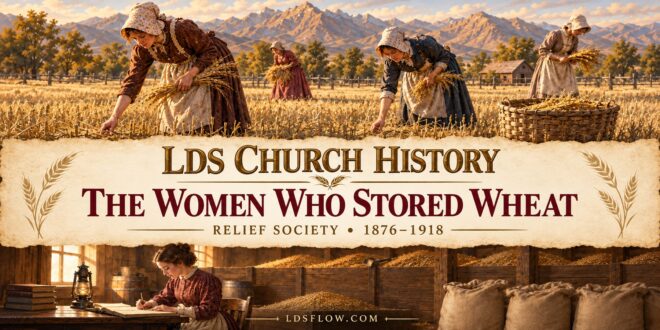
One woman had a grain bin to offer. Another reported an empty treasury. A third warned that frost had ruined wheat in three counties. When Relief Society leaders gathered in Salt Lake City’s Social Hall on November 17, 1876, their assignment was simple to describe and difficult to carry out: obtain wheat, protect it, and hold it for a future day of hunger.
The Relief Society grain-storage program would eventually reach far beyond that meeting. Its most revealing beginnings, however, lie in the questions the women asked each other. Where could they buy wheat? Who would pay for the labor? Should each congregation keep its own supply? How could they stop insects from destroying what they saved?
These were women trying to turn religious conviction into food someone could actually eat. Their story gives us a different view of pioneer courage: the patience to prepare, organize, and keep working before a crisis arrives.
The meeting behind the movement
The Church Historian’s Press edition of the November 1876 minutes explains the immediate background. At Brigham Young’s request, Emmeline B. Wells had used the Woman’s Exponent to encourage grain storage. A central committee formed with Wells as chair and Eliza R. Snow and Bathsheba W. Smith as members. The November 17 gathering brought central and local leaders together.
Young had urged grain saving for years. The new effort put women in a position to organize a collective response. Their concerns included both the practical danger of shortages and a religious expectation of coming calamities. Understanding those beliefs helps explain their urgency without requiring us to treat every later emergency as a specific prediction fulfilled.
The surviving minutes, originally published in December 1876, let us hear the meeting’s priorities. Wells asked participants to concentrate on the grain question and make good use of their time so the women could get home. Then she invited local Relief Society presidents to offer their ideas.
That opening matters. The work needed more than an announcement from the front of the room. It needed information from the people who knew their neighborhoods, their available resources, and their limits. The meeting became a place to compare those realities.
Faith met an empty treasury
Snow spoke about preparing for famine and feeling compassion for people who might come seeking help. Then she moved directly to the practical problem: acquiring and caring for the grain. Would the women work through individual wards, through a central organization, or through some combination?
Wells reported that Bishop Edward Hunter had offered storage space at the Tithing Office. Space, however, did not automatically include workers. The men already employed there were fully occupied. If the women used the building, they would need to arrange additional help.
Sarah M. Kimball brought encouraging news. Her ward had appointed a visiting committee, and the people it contacted were willing to contribute. She wanted to know the next steps. Elsewhere, readiness looked different. Annie Savage said the Twentieth Ward intended to do its best, but its treasury currently held no funds.
The record preserves both reports. There is no need to smooth the contrast away. A shared commitment did not mean identical means. Some women could offer money, some organization, some storage space, and some the willingness to begin despite having little immediately available.
Buying wheat was only the beginning
Wells asked where grain could be purchased. Elizabeth Goddard had heard that wheat was available for a dollar a bushel. That was a report brought to the meeting, rather than a price we can assume applied everywhere.
Elvira S. Barney supplied a sobering correction to any easy assumption that grain would be plentiful. She reported that early frost had devastated wheat in Morgan, Summit, and Wasatch Counties, leaving none there for sale. Her account put a local face on the very problem the women hoped to prepare for.
The discussion then moved from obtaining a reserve to keeping it usable. Rachel Grant reported that the Thirteenth Ward had been offered a large bin. Marinda N. Hyde explained that women in the Seventeenth Ward were considering a smaller meeting hall so part of the space could accommodate wheat storage.
A woman identified in the minutes as Mrs. Chase offered another bin. She also remembered a warning from experience: her husband’s stored wheat had once been spoiled by weevils. She still wanted the effort to succeed. Her contribution joined generosity with an honest account of what could go wrong.
Read together, these exchanges make an unusually concrete picture of service. Purchasing grain was one task. Finding a sound building, arranging labor, watching for loss, and deciding who was responsible were others. Good intentions had to survive contact with weather, pests, budgets, and competing uses for a small room.
A purchasing committee—and a record of every gift
Louisa G. Richards suggested pooling the money and appointing an energetic buyer. Snow favored adding her own contribution to the common supply. The meeting eventually approved a general purchasing committee while leaving room for wards to maintain their own committees.
Barney, Elizabeth Howard, and Kimball were elected to purchase grain. Priscilla M. Staines was sustained as treasurer. The women also proposed keeping ward records that clearly identified each donor and contribution. The assignment now had people attached to it, and the gifts would have a written record.
It is easy to hurry past those administrative details on the way to a dramatic outcome. Yet they are central to the story. Someone had to know what had been promised, what had arrived, and who was caring for it. A movement intended to endure needed a memory more dependable than recollection.
The minutes also reported that Manti already had sixty or seventy bushels stored. That early progress gave the gathering something tangible to consider. The work could start with a limited amount, in a particular place, under particular people’s care. A vast reserve did not have to appear all at once.
Small contributions became usable reserves
In her 1978 account of the wheat program, Relief Society general president Barbara B. Smith described women gleaning fields when they lacked cash. They also sold or traded eggs, quilts, rugs, cheese, and other goods for wheat. The reserve grew through ordinary work and many forms of contribution.
The Church’s history Daughters in My Kingdom records that Kimball’s ward built a fireproof granary with room for 1,000 bushels during the project’s first year. It also identifies concrete occasions when the stored grain helped people: the southern Utah drought of 1898–1899 and relief after the 1906 San Francisco earthquake and fire.
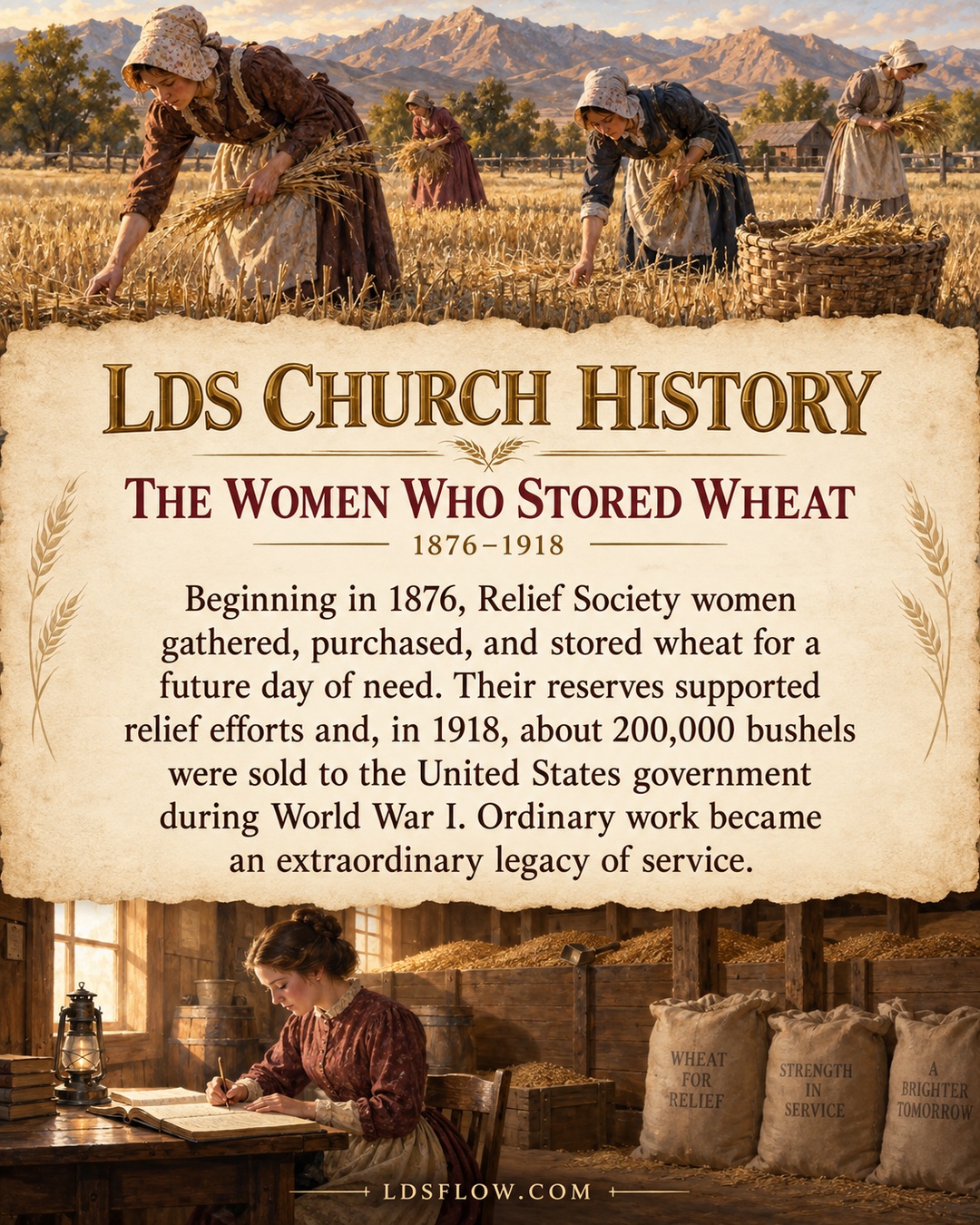
During World War I, the program took on another role. In 1918, about 200,000 bushels of Relief Society wheat were sold to the United States government to address wartime food needs. The word sold is important: this was a transfer of grain in exchange for payment, rather than a donation of the entire reserve.
The scale is striking, but the figure should not erase the earlier work. Behind a total measured in hundreds of thousands of bushels were individual purchases, storage decisions, donations, and records. Those modest activities made a larger response possible.
What happened after the wartime sale?
Smith’s 1978 report explains that income from the wheat proceeds supported maternity, child-welfare, and other health work. Relief Society purchased wheat again in 1940 and stored it at Welfare Square. In 1978, Smith presented 266,291 bushels and associated wheat assets for incorporation into the Church’s wider grain-storage program; President Spencer W. Kimball accepted the gift.
This was a continuing institutional legacy, with sales, funds, and later purchases. It does not mean grain harvested in 1876 sat untouched until 1978. The distinction helps us appreciate the stewardship involved: preserving the ability to help as circumstances changed.
There is a useful companion here to the story of Ephraim Hanks and the handcart rescue. Rescue makes urgent demands on people when suffering is already visible. Preparation asks them to work when the need may still be distant. Both deserve a place in the way we remember service.
The courage to begin before the need is visible
The November 1876 minutes leave us with an encouraging kind of history. The women did not arrive with unlimited money or a complete system. They brought questions, imperfect resources, local knowledge, and a willingness to accept responsibility.
For readers considering how to carry the pioneer spirit into everyday life, that is a useful point of reflection. We can notice the people who quietly maintain a community’s capacity to help: those who keep records, organize volunteers, care for supplies, and follow through when enthusiasm fades.
Those jobs rarely become the most famous scene in a historical painting. But in the grain-storage story, they are where much of the courage lives. The women made room for another person’s future need—sometimes by making a little less room for themselves—and then began the work.
Source note: The meeting narrative draws on the contemporaneous November 17, 1876 minutes, published in the Woman’s Exponent on December 1, 1876. Later outcomes are drawn from the linked Church history and Barbara B. Smith’s retrospective and presentation in 1978. The artwork is a modern illustration of the work, not a documentary image of the named participants.