LDS Flow A comprehensive online experience for members of The Church of Jesus Christ of Latter-day Saints.
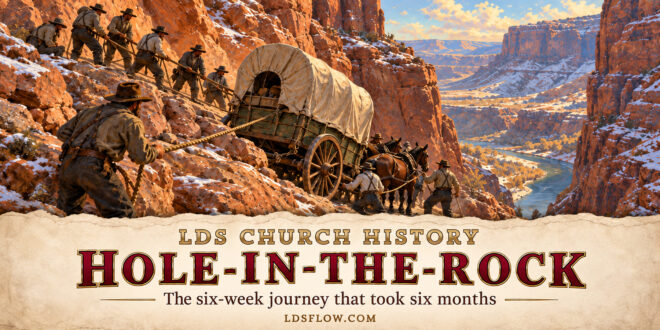
The road stopped at a crack in the sandstone. The families still had to get their wagons down.
In the winter of 1879–1880, a company of Latter-day Saint settlers confronted a problem that seems almost impossible to picture from a modern highway: how do you move a wagon train, children, supplies, and livestock through a steep passage above the Colorado River when no usable wagon road exists?
Their answer took weeks of labor. They widened rock, built a route, and prepared to control the wagons as they descended. The expedition remembered as Hole-in-the-Rock became one of the most striking examples of practical ingenuity in Latter-day Saint settlement history.
But the famous descent is only the middle of the story. Understanding what brought the families there—and what still lay ahead—reveals a richer history of faith, difficult decisions, teamwork, and the exhausting business of building a community.
A mission that meant moving a household
The San Juan mission belonged to a period when Church leaders called families to establish settlements beyond the communities already growing in Utah. These assignments could require much more than a temporary absence. A household might have to give up an established livelihood and carry the essentials of a new life into unfamiliar country.
The Bluff Fort Historic Site’s account describes people selling farms and businesses to answer the call. The mission combined settlement in southeastern Utah with the stated goal of developing peaceable relations with Native peoples in the Four Corners region. The move was therefore religious, economic, and communal all at once.
It helps to pause over that ordinary word, families. A wagon did not simply carry adventurous adults. It carried the provisions, bedding, tools, and other possessions on which a household’s future depended. A difficult route put both the travelers and their means of starting over at risk.
The shortcut that became a winter’s work
According to the National Park Service’s history of the expedition, a scouting party led by Silas S. Smith explored the region in 1879. A settlement site near the mouth of Montezuma Creek on the San Juan River was identified, but the route remained a problem. The longer alternatives would have required a journey of nearly 500 miles.
The company gathered at Forty-Mile Spring, south of Escalante, in November 1879 to attempt a shorter way. The Park Service gives the party’s size as approximately 250 people, 83 wagons, and more than 1,000 livestock. Other historical summaries give slightly different totals; these numbers are best understood as an indication of the undertaking’s scale.
A short distance on a map can conceal a formidable problem on the ground. In canyon country, the next destination may be visible while a workable route to it remains painfully indirect. The travelers needed a passage that a loaded wagon and its team could negotiate, not merely a place where a person on foot could scramble.
How they made a road through the rock
A Church magazine account, “About the Hole-in-the-Rock,” describes the work in three parts: widening the opening, creating the descending road, and preparing a route up the opposite side of the river. The tools were basic, the supply of blasting powder limited, and the terrain unforgiving.
The account describes workers drilling holes in the stone to support a constructed section of roadway. Posts, poles, brush, and earth helped create footing where the natural surface did not provide it. This was a construction project as much as a migration.
That detail changes the familiar image of pioneer endurance. The families were not simply waiting for an obstacle to disappear. People assessed the rock, divided the work, and made repeated physical changes to the route. Their confidence had to become coordinated action before a wagon could move.
It also explains why the story cannot be reduced to one fearless individual. A team holding a rope depended on the people who had prepared the road. A driver depended on the restraint applied behind the wagon. Each stage relied on work someone else had already done.
January 26, 1880: the descent begins
The National Park Service dates the beginning of the descent to January 26, 1880. Charles Hall and others had built a ferry to carry the travelers across the Colorado River once they reached it.
The Church’s account explains that wagon wheels were chained and men used ropes to hold the vehicles back. Women and children could make their way down on foot. It reports that no wagon was lost during the descent.
The central task was control. Getting a heavy load moving downhill was not the achievement; keeping it from moving too quickly was. The slow pace, the ropes, and the prepared road are the substance of the feat. They deserve as much attention as the cliff itself.
Arabella Smith and the importance of naming the source
One of the expedition’s best-known family stories concerns Joseph Stanford Smith and his wife, Arabella. In an April 1982 general conference address, Elder G. Homer Durham recounted a narrative preserved by their grandson and cited historian David E. Miller’s treatment of the expedition.
In that telling, Smith returned after helping other wagons and found his own family still waiting. Arabella helped restrain their wagon as it descended, suffering an injury in the struggle. After reaching the bottom, her husband went back for the children.
This is a later family account, rather than a transcript recorded beside the wagon. Identifying it that way allows readers to appreciate both its place in Latter-day Saint memory and the nature of its evidence. We do not need to invent additional conversation or inner thoughts to make the episode powerful.
Arabella’s role also widens the picture. A history told only through expedition leaders and road crews can overlook the household labor and physical courage on which the whole company depended.
The river was not the finish line
The Historic American Engineering Record for the Hole-in-the-Rock Trail, preserved by the Library of Congress, identifies several major obstacles along the approximately 180-mile route between Escalante and Bluff. Beyond the Colorado crossing came difficult terrain at Grey Mesa, Clay Hill, and San Juan Hill.
That engineering record emphasizes human and animal labor: clearing rocks, boulders, and trees so wagons could pass. Blasting powder was available for some work, but it could not replace the sustained effort of the people and their teams.
The celebrated passage through the cliff therefore did not end the road building. Success at one barrier left the company facing another. A journey expected to take about six weeks stretched to about six months.
It is tempting to end an adventure at its most dramatic scene. Doing so here misses something essential. The families had to keep working after the moment later generations would remember most vividly.
Bluff: arrival brought a different kind of challenge
The Bluff Fort account places the establishment of the community in April 1880. The settlers built cabins, planted crops, and began making a home along the San Juan River.
They were entering a region with a long human history. Bluff’s local history overview describes earlier Ancestral Puebloan communities and the presence of Ute, Paiute, and Navajo peoples. Honoring the expedition’s perseverance does not require presenting the country as an empty stage awaiting settlement.
The same local history describes the uncertainty of farming beside a river that could flood or provide too little dependable water. Later economic activity and further moves reshaped the community. Arrival did not produce a permanent escape from difficulty.
This makes the story more recognizable. A family can accomplish a demanding move and still have to earn a living, care for children, and decide what to do when the first plan does not work. The destination begins another chapter.
What this history asks of us
For a modern reader, Hole-in-the-Rock offers a useful way to think about perseverance. Religious conviction and practical preparation appear together in the story. Faith mattered to the settlers; so did tools, teamwork, road construction, and the willingness to perform slow work.
Our challenges rarely resemble lowering a wagon into a canyon. Yet the habit of breaking an overwhelming problem into tasks other people can help carry remains valuable. Someone prepares the way. Someone steadies the load. Someone looks after the people who are too young, tired, or vulnerable to do either.
Readers interested in that connection can explore LDS Flow’s reflection on applying the pioneer spirit today. For another distinct episode of practical courage, our Ephraim Hanks handcart-rescue feature follows the work of helping people already in danger.
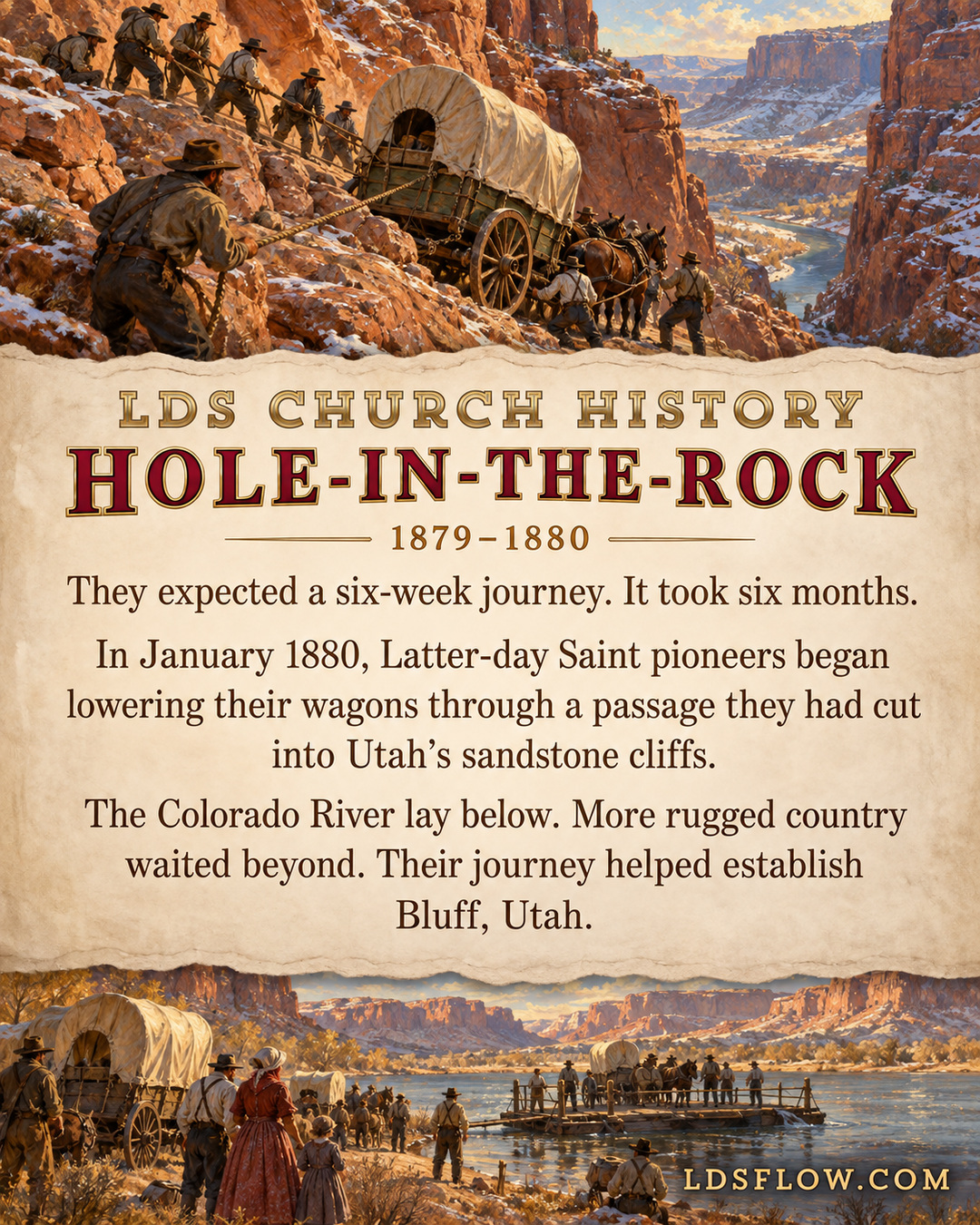
Remember the people holding the ropes
The enduring image of Hole-in-the-Rock is a wagon on a steep road. Look a little longer, and the picture fills with other people: the workers who prepared the passage, the hands restraining the load, the families waiting their turn, and those preparing for the crossing below.
That is the story worth carrying forward. A daunting obstacle became a shared assignment. The route demanded more time and labor than the travelers expected, and the community they eventually built required still more. Their history invites admiration for the dramatic moment and respect for the patient work surrounding it.
Source note: Historical totals and descriptions of the descent vary across summaries. This feature attributes specific figures and distinguishes the later Smith family narrative from contemporary documentation. Artwork is an AI-generated historical illustration, not a photograph or an exact reconstruction.